
Two-part podcast episode about the Working-Class Literature Festival held every year in Florence, at the former GKN car parts factory, which was taken over by the workers after they were made redundant in 2021.
Our podcast is brought to you by patreon supporters of both Working Class Literature and Working Class History. Our supporters fund our work, and in return get exclusive early access to podcast episodes, bonus episodes, free and discounted merchandise and other content. Join us or find out more at patreon.com/workingclasshistory
Episodes

WCL10: Florence Working-Class Literature Festival, part 1 – Working Class History
- Part 1: The GKN workers’ struggle: the redundancies and factory takeover in July 2021; how the idea for the Working-Class Literature Festival began, and the organisation of the first two events (despite attempts at sabotage)
WCL11: Florence Working-Class Literature Festival, part 2 – Working Class History
- Part 2: What events took place at the first two festivals, the participation of the GKN workers themselves, and the experiences at the festival of two authors: Anthony Cartwright and Claudia Durastanti.

More information
- Come to this year’s festival! April 4-6.The organisers are encouraging anyone interested to attend. Entry is free; just turn up at the GKN factory on Via Fratelli Cervi in Campi Bisenzio. Click here for the full programme for this year, plus info on how to get to the festival
- To donate money to support the GKN struggle, make a bank transfer to:
- Account name: Aps Soms Insorgiamo
- IBAN: IT75E0501802800000017261280
- Read some of the books mentioned in these episodes:
- Insorgiamo: Diario Collettivo di una Lotta Operaia (e non solo) [“Let’s Rise Up: Collective Diary of a Workers’ Struggle (and not only)“] – GKN Factory Collective
- Down and Out in England and Italy – Alberto Prunetti
- How I Killed Margaret Thatcher – Anthony Cartwright
- Strangers I Know – Claudia Durastanti
- On the Line – Joseph Ponthus

Images
Our interviewees


Working-Class Literature Festival 2023
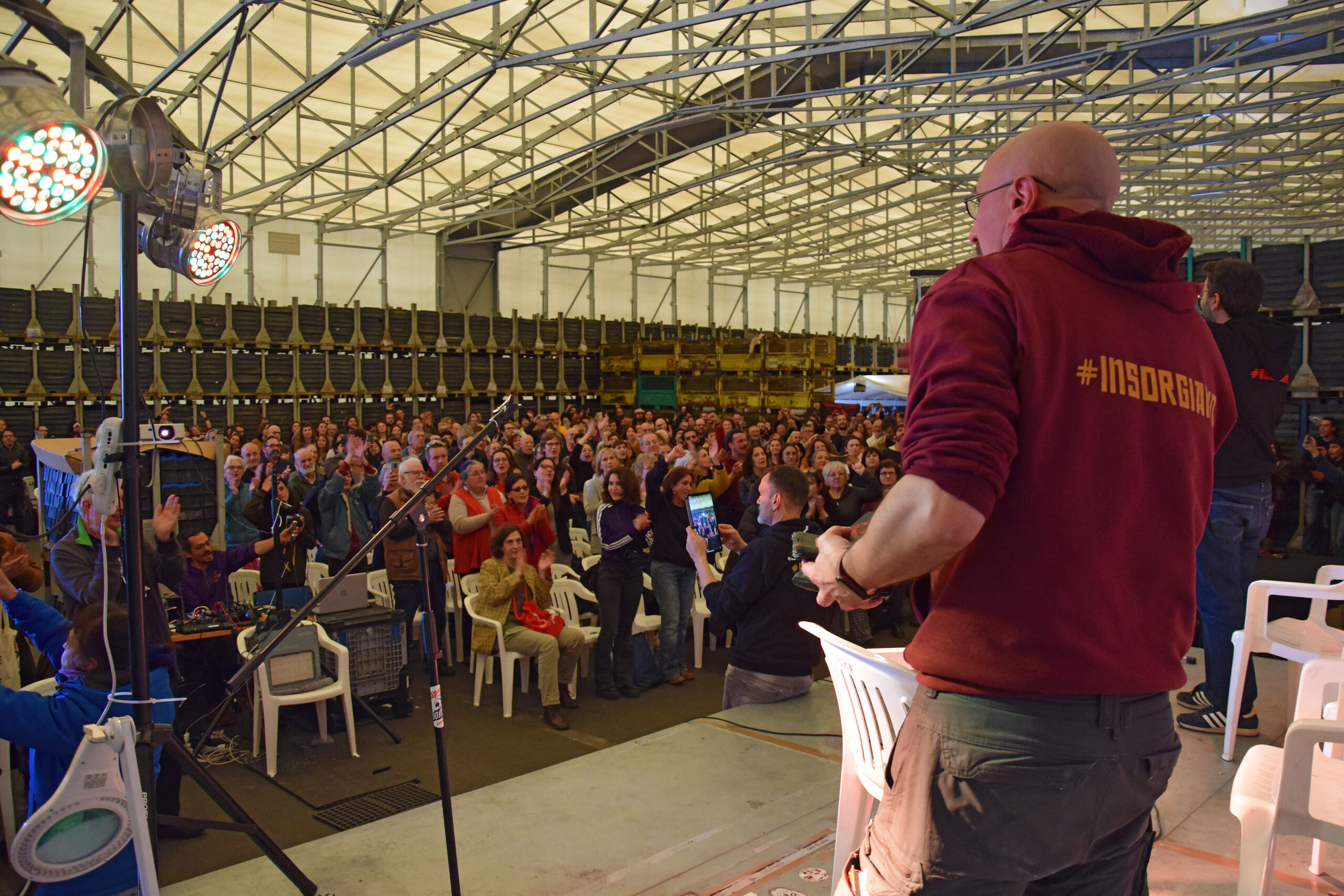


Working-Class Literature Festival 2024


Video
If you want to learn more about the struggle at GKN, we highly recommend this documentary by Reel News London.
Acknowledgements
- Many thanks to Antonella Bundu for doing the voiceover for Tiziana’s audio
- Many thanks also to Alberto Prunetti and Edizioni Alegre for giving us permission to reproduce photos from previous years’ festivals
- Thanks to all our patreon supporters for making this podcast possible. Special thanks to Jamison D. Saltsman, Jazz Hands, Fernando Lopez Ojeda and Jeremy Cusimano
- Our theme tune for these episodes is ‘Occupiamola’ (or ‘Let’s Occupy It’) as sung on a GKN workers’ demonstration in 2024. Many thanks to Reel News London for letting us use their recording. Watch the documentary it’s taken from here
- This episode was edited by Tyler Hill
Subscribe
Listen and subscribe to WCL in the following ways: Apple Podcasts | Spotify | Amazon Music | Anchor | Castbox | Google Podcasts | Stitcher | Overcast | Pocket Casts | Podbean | RSS
Listen and subscribe to WCH in the following ways: Apple Podcasts | Spotify | Amazon Music | Anchor | Castbox | Google Podcasts | Overcast | Pocket Casts | Podbean | Radio Public | RSS | Stitcher | TuneIn
Transcript
Part 1
Matt: In July 2021, over 400 workers at the GKN car parts factory on the outskirts of Florence were told that they would lose their jobs. In response, workers seized the factory and, in the past four years, their demands have developed beyond just stopping the redundancies, but to restarting production under workers’ control, building ecological goods and promoting green, community-controlled energy. And, as if this wasn’t enough, since 2023 the factory has also become the site of the annual Festival of Working-Class Literature. The third installment of this festival will take place this year in April 2025. This is Working Class Literature.
[intro music – Occupiamola as sung on a GKN demonstration in 2024]
Matt: Before we start, a quick note to say that we’re only able to continue making these podcasts – both Working Class History and Literature – because of the support of our listeners on Patreon. If you like what we do and want to help us with our work, join us on patreon.com/workingclasshistory where you can get benefits like early access to episodes, exclusive bonus content, discounted books, merch and more. For instance, patreon supporters can listen to both episodes about the Festival of Working-Class Literature now, and also have access to our two Patreon-only series, Radical Reads and Fireside Chat. Link in the show notes.
On 4 April this year, a weekend of readings, discussions, and performances will be held in Florence at what will now be the third annual Festival of Working-Class Literature. And, as in previous years, the organisers are encouraging people from all over the world to attend.
However, while literary festivals are usually rooted in spaces linked to publishing or academia (and often bankrolled by businesses looking for nice PR to cover their involvement in genocide or environmental destruction), this festival is very different. Held at the former GKN car parts factory in Campi Bisenzio on the outskirts of Florence, it emerged from the struggle of over 400 workers who were made redundant in 2021. So to tell the story of this festival, it’s essential to first tell the story of those workers and their struggle.
Alberto Prunetti: Everything started in July 2021 but there was a kind of prequel in some ways. We need to go back to something that happened not in Florence but in England.
Matt: This is Alberto Prunetti, an Italian working-class author and one of the main organisers of the festival.
Alberto Prunetti: GKN is a British company and they are a corporation working in the automotive field. In 2018, they were relatively productive and not really in a bad economic situation. The corporation was acquired by another corporation, Melrose, which is a strange player because Melrose doesn’t really work in the automotive industry. They are more like a financial player. What they do is buy companies and relocate plants to Eastern Europe after firing workers and then, after four or five years, they sell the factories. They don’t really produce anything. They earn money more in finance and real estate. It seems that after Melrose acquired GKN, they started to close plants in Europe and in the UK as well because they closed the Birmingham plant. They sold plants in Germany and also in Campi Bisenzio, the industrial area north of Florence.
Matt: This kind of company, which produces nothing but merely invests and speculates around commercial real estate or acts as a consultant helping companies ‘maximise efficiency’, is an increasingly common feature in today’s global capitalist economy.
Dario Salvetti: Its main slogan is ‘To buy, to improve and to resell’. You have to understand that to improve means cutting jobs and closing plants in order to gain financial profits from productive groups.
Matt: This is Dario Salvetti, a worker at the former GKN factory and spokesperson for the factory collective. Here, Dario explains how the company tried to trick workers to keep them away from the factory while they tried to close it down.
Dario Salvetti: On Friday, 9 July 2021, we received a collective day off or holiday and the excuse was that the production of Fiat was slowing down a little bit so everybody could stay at home for one day. While we were at home, we received an email in which they told us that the plant was shutting down suddenly and totally and that we were invited not to come back to our jobs ever again. After one hour, we decided to gather in front of the factory and retake our presence inside the factory. We started what we call a “permanent assembly”. We had 400 workers at the time and now we remain with 120 workers.
It’s now been more than three years that we have been going on with the permanent assembly of the workers. To sum up, the history of GKN is a history that contains a lot of histories. You could say that it’s the history of the transformation of a productive factory into a real-estate investment. It’s the history of the loss of jobs inside the automotive sector. It’s the history of the impact of international financial funds and the financialisation of the economy on the productive forces. Now, it’s also the history of the longest workers’ resistance, from what we know at least, in the history of the Italian working-class movement.
Matt: The workforce at the GKN factory is almost entirely male, the only woman being Tiziana De Biasio, who worked for the cleaning contractor. Here she explains how she joined the factory, her role in disciplining union members, and how the company retaliated when she refused to do so.
Tiziana De Biasio: I started working at GKN in 2012, working for an external contractor, and I was the only woman working in the workshop. I was responsible for coordinating the cleaning services. So, every morning, I had to rush to make sure the production areas were tidied up; otherwise, the first shift workers, who started at six, would complain about finding everything in disarray.
When I had the interview to join the factory, the managers from GKN and the executives of the subcontracting company were present. My main responsibility was personnel management and acting as an intermediary with the labor consultant and the GKN management. There were three contracts: cleaning services, goods handling, and quality control. The cleaning services were mostly handled by women, while the other two were almost entirely carried out by foreign workers, mostly Romanian and Albanian men. They told me it wouldn’t be easy dealing with them… because before me there had been a man, and it hadn’t gone well at all. So, they thought a woman might be more suitable because women are supposed to be treated with special respect—no one would say to a woman, “I’ll wait for you outside” or “I’ll beat you up.” At that point in time, I was also useful because they told me they needed to get rid of a few “problematic” people. These were the ones who had been unionized, so for every minor infraction, I had to report it and issue disciplinary actions so that after the third, they could be fired. At first, I played that role because I desperately needed a paycheck, and especially because they were sexist and misogynistic—they played a lot of pranks on me…
Over time, I got to know my colleagues, and I started to see them not just as men, but as workers, like my husband, like my father… Workers who, if one of them got fired, would be ready to go on strike, and I had to be on the company’s side; I couldn’t strike with them… I began to wonder why they were so aggressive with me: Was it because I was a woman, or because I was their boss? I didn’t know… I just know that I stopped reporting… And those who once didn’t even call me by my name, just “that woman,” later started calling me Tiziana. Strangely, though, the factory managers started calling me “that woman”… so, in life, one way or another, there’s always someone who calls you “that woman…”
Then, after a few years, there was a change in the subcontracting agreement, meaning the services were given to another company. Since I had become a “problematic” figure for the client, they asked the new company to downsize me to force me to resign… For a while, I even cleaned the toilets, but I never gave them the satisfaction of resigning.
Matt: When the layoffs at GKN were announced, Tiziana was one of the hundreds who lost their jobs. She immediately got involved in the struggle and is an active member of the factory collective to this day. Speaking at an event at the GKN factory in 2024, Tiziana explained how “gender discrimination is still strong in our society and so for me it was important to stay in that place […] I don’t want to give up and I want to continue to represent that world of different genders in this exemplary struggle.”
Another thing that should be noted is that, unlike much of the coverage in the mainstream media, the workers at the ex-GKN factory do not describe their continued presence inside the factory as an ‘occupation’. Instead, they use the phrase ‘permanent assembly’.
Dario Salvetti: It’s not a question of what we prefer; it’s a question of what it is and what it is not. If you think about an occupation of a factory, you could think about a factory that is functioning very well and the workers decide to block the factory. This is not the case for us. We were working and private capital decided to fly away from our factory and leave the factory as a black hole without any kind of direction or any kind of productive mission you could say. In this case, the Italian workers’ movement has tried to define the most legal way in order to put our bodies into the factory in order to defend the factory from what we call delocalisation, from taking away the productive means.
We are exercising our own rights to stay in a trade union assembly inside our workplace but this is an assembly that is not ending. It’s a permanent assembly which started on 9 July 2021 and it will go on until the moment we think that job positions are safe and we can restart work.
Matt: And, indeed, when the workers say that since 9 July 2021 there has been a permanent workers’ assembly, they really mean permanent.
Dario Salvetti: There is the trade union garrison where we are 24 hours a day every day, including Christmas Day and Easter. Since 9th July 2021, there has always been a shift of people in the garrison from 6 o’clock in the morning to 2 o’clock in the afternoon, from 2 o’clock in the afternoon until 10 o’clock at night and from 10 o’clock until 6 o’clock in the morning. We are always there because, of course, our permanent assembly and our permanent presence in the garrison is, at the moment, the only guarantee that the factory will not be dismantled.
Matt: The ability of the workers at Campi Bisenzio to react so quickly and effectively to the redundancies was because they were extremely well organised, both as members of the FIOM metalworkers’ union with a strong history of activity inside the factory, but also in the wider community outside of it as well.
Dario Salvetti: There were a lot of links before the shutting down of the factory. It’s clear that it was partly a result of the tradition of this area of Italy which is very partisan and anti-fascist. It’s a radical, democratic tradition that we have in this area. Partly, it was because we succeeded, for at least 20 years, in defending the social rights of the workers in order that our degree of exploitation inside the factory was less than in other factories. This has an impact on your life because if you work from Monday to Friday and when you stop working, you are not completely exhausted, you have the time and also enough wage to do other things in your life. We were a factory full of active people; active in every direction: football trainers, volunteers in medical assistance, and social activists.
So when the factory was closed, there were a lot of people who thought, ‘They’ve closed our factory’. Not just the people who were working inside the factory. There was a whole movement that thought, ‘They are closing the factory that is supporting us’. It’s a factory that is always full of solidarity movements and with social links.
Matt: These links between the GKN workers and the wider working class and social movements in the region also had a profound effect on Alberto who remembers one of those early mobilisations.
Alberto Prunetti: After receiving the dismissal letters, workers in the union declared a general strike day only in Tuscany with speeches in Piazza Santa Croce in Florence. I realised it was something important. I already knew a few of the GKN workers because they were very active. These workers were… they still had a reputation in Tuscany for their engagement in politics. I could hear Dario Salvetti, the spokesperson of the workers. He said something that really struck me because it was more or less what I was already trying to do with my work as a writer. He was talking with journalists and he said, “We are not here to tell you our stories. We are here to write our own story.”
This struck me a lot. It was my kind of manifesto of the working class. It was something that I had been saying for years but only in my books. Now it was real. It was not something from the past. It was something that was real and now. Very often, I wrote about the blue-collar workers of the past like my father who was a welder, working in the other century now! Now we had here these self-conscious workers strongly engaging in defending their wages who spoke in a very lively language. It was amazing. They were talking like winners. They were strong and powerful. It was absolutely amazing. It was something that didn’t happen very often. I was really struck by them… everybody was.
This summer was a kind of summer of love for the working class after years in which everybody said that the working class didn’t exist, we were all middle class, all this kind of rhetoric. It’s true that the political imagination of the working class was defeated many years ago at the beginning of the 80s in Italy. Since then, there has not been such a strike that had been so strong. It came and it was amazing because the GKN workers were really great at putting it all together. Even school boys were singing their anthem, Occupiamola.
Matt: Occupiamola is the song that we played at the start of this episode and is frequently sung at demonstrations of GKN workers in Florence. The song is actually adapted from one sung by fans of the local football team, Fiorentina, but with the lyrics changed to be about the GKN workers’ struggle.
The mobilisations of GKN workers and their supporters brought huge numbers onto the streets. And, in doing so, they brought the working class back into the public imagination.
Alberto Prunetti: In September 2021, they were able to bring 40,000 to march through the streets of Florence. It was impressive having 40,000 supporting workers’ mobilisation. I realised that in two months, the GKN workers in Florence had reconstructed the working-class imagination that had been defeated for 25 years. I was trying to do the same with my books as a writer, but in ten years, I couldn’t do anything compared to them. In two months, working in a collective way, they have done much more than me because I was working alone as a bourgeois writer even though I’m a working-class writer. It’s the loneliness of the long-distance writer while their power is the power of collective action. So, it was really powerful.
Matt: For Alberto, the strength of the GKN mobilisation allowed for a kind of working-class imagination that he had been trying to produce in his writing. This kind of imagination can be seen in how the GKN workers have more recently gone beyond demanding better redundancy pay or their old jobs back, but rather the wholesale renewal of production under workers’ control to build ecologically-sustainable goods such as pedal-powered cargo bikes, and solar panels with a view to promoting democratic community-controlled renewable energy, as Dario here explains.
Dario Salvetti: You don’t have to imagine that, one day, people have gathered at a meeting and have to start to say, ‘Let’s convert the factory.’ It has been a process in which we have just filled the vacuum that capital has created against us. The lay-offs were declared in July ’21 because Italian law gives 75 days for the conversion of this procedure of lay-offs in a definitive decision. We had time to stop this decision until September ’21. We called three big demonstrations and the biggest one was with 40,000 people.
The Florence labour courts declared the procedure of lay-offs were illegal so the ownership was condemned, not to avoid the lay-offs, but to repeat the legal procedure of lay-offs. What happened is that they had burned their fingers with the first procedure of lay-offs so they didn’t restart with lay-offs. They probably decided to leave us in a kind of limbo. In September ’21, we were not fired, officially. We were completely hired with full rights. For a period, we received a wage without working but we were left in a vacuum because there was nothing to do. We were in a factory which is quite a new factory with a lot of new machines.
In this vacuum, we had to rethink how we could restart the factory with another industrial plan. Our first industrial plan, in December ’21, was just a general social proposal in which we told the Italian government, ‘Why don’t you nationalize this factory and other automotive factories in order to create a big sector of production of the public means of transport in order to make a real transition from the private automotive sector to a real ecological sector that is not shifting from a gas car to an electric car but is shifting from private car to a public means of transport?’ Of course, they didn’t give us any answer and it was not possible for us to achieve this plan on our own because it was a general social plan.
In January ’22, another private owner came along who bought the factory but it was something that felt very suspicious because this owner was the former advisor of the old owner of GKN. This owner didn’t say, ‘I’m firing you.’ This new owner said, ‘I don’t have capital or work but, in the summer months, I will bring you new investors.’ We thought the trick could be to let us wait in the vacuum waiting for Godot, waiting for something, we didn’t know who or what. We thought it was done in order that the struggle would expire due to tiredness. We didn’t expire. We called for other demonstrations together with the climate movement. There was another big demonstration in March ’22 with 30,000 people and in October ’22, it was quite clear and official to us that there was no industrial plan. There was probably no real intention of this new owner to reindustrialise the factory.
This time, we had to create our own plan; not a general plan but a plan of a standalone factory; not a factory of the automotive sector but a factory which was a single productive cell. It was not easy but we decided to try to produce some finished goods like the cargo bikes and photovoltaic panels in order to have some finished goods that we could take by ourselves to the market to convert a former automotive factory to an ecological factory. Of course, because this plan was made by us, this plan had also to be based on different social forces and not with a big private owner but our own cooperative. We formed an embryo of a workers’ cooperative. We called for a public popular shareholding campaign that collected the bookings of €1,300,000 stock options but it was not enough because the ownership of the old factory, which was a very big factory, was something too big for us. We cannot rebuy the factory. We cannot, and we don’t want to because it’s not our idea that the workers have to rebuy it with their own money. We have presented a law that has been passed by the regional government in which the regional government could create a public consortium to take control of the land.
This kind of example or this kind of model is what we have called a socially integrated factory. That means that the land is public and the public is under the control of the cooperative and the decisions of the workers’ assembly that has gathered into a cooperative. There is a kind of social control from below because we have thousands and thousands of popular shareholders that are made by associations, by other cooperatives, maybe by some public institutions like universities. Also, the production is green production: solar panel production is linked to the energy communities which we would like to spread to the whole country. The cargo bike production could be linked to the delivery cooperatives that are trying to transform urban deliveries especially into something that is not so exploitative as it is nowadays in our cities.
We have arrived at this kind of model not in one day and just decided that this is the model. It was not a theoretical discussion. It was answering the fact that to let us get exhausted by the struggle, the private capital has just escaped leaving a black hole of a factory and using against us the fact that, in this society, private capital is the only one that can decide the life and death of production.
Matt: This plan was something which emerged directly from the conditions of the GKN workers’ struggle. It emerged from the strength and resolve that so inspired Alberto during those first protests in the summer of 2021, and it would be shortly after those protests that these ideas of struggle and literature and the working-class imagination would crystallise into something more concrete for him.
Alberto Prunetti: After 40,000 people demonstrated, more or less a month later in the fall of 2021, I got an invitation from the Working-Class Writers’ Festival in Bristol and that was the first working-class literature festival in Europe. I was invited by the organiser and it was a great opportunity for me because I was happy to go back to Bristol, the city where I worked as an immigrant worker from Southern Europe more than 20 years ago. I learned a bit of English and I cleaned toilets and worked as a kitchen assistant. It was the place where I discovered British working-class literature that was so important to me for my work later on.
Matt: The experiences Alberto mentions here about his time living and working in Bristol make up his novel, Down and Out in England and Italy, translated and published in 2021 by Scribe Publications. The book got a very unsympathetic review in the British right-wing rag, the Daily Mail. In that review, the journalist describes Alberto as a “very sweary, grizzled old Italian lefty.” We’ll include a link to the book in the show notes.
The Working-Class Writers’ Festival in Bristol was an excellent event. But, for Alberto, there was also something missing from it.
Alberto Prunetti: It was a great opportunity but I could also feel the distance from the kind of workers’ atmosphere that we had in Italy in those days because we had a mobilisation to fight inside the class strike in some way. The Bristol festival was more a kind of cultural thing. I had the idea we should organise a festival in Florence, not for the workers but with the workers. That means that the workers should be our leaders in these things in some way. I started to speak with a few of them and this idea was, in some way, interesting but they were also fighting for something that, according to a lot of them, was more important, of course, which was their wages. Some people said, ‘Yes, it’s good,’ and others said, ‘Yeah, but we have to first fight for our wages.’
With a few workers, we organised something that was called Convergenza Culturale. It was a kind of small group within the workers’ collective. In the beginning, they only organised small events or even big ones and there were book presentations and talks about literature in a big square near the GKN factory. My idea was not to organise small talks or book presentations but a huge festival. It took time because it’s not something that you can do out of the blue.
Finally, in 2022, we managed to create a working group, a new cultural convergence group, and we brought together a few workers from the GKN collective and some other workers from the publishing industry, plus several activists from SOMS which is a kind of society of mutual aid that has a long tradition from the last century in Italy. We brought all these people together to build the new festival. I was asked to be the so-called artist director, this kind of cultural marketing neologism. I engaged myself to create a programme in order to give shape to the first event of the Working-Class Literature Festival in Italy.
Matt: However, while more conventional literary festivals usually get some kind of financial backing from either publishers or big-money sponsors, the Festival of Working-Class Literature had neither. Instead, the festival relied on the solidarity of social movement institutions.
Alberto Prunetti: It wasn’t easy. I mentioned SOMS but also Arci Toscana which is a deeply-rooted organisation in Tuscany. You find an Arci in every small village in Tuscany and they are a… in some ways, they are like a pub but in another way, they’re more a kind of social centre but they belong to the left and the labour movement. You find a lot of them all around Florence. We had this network of small Arcis that were strongly related to the territory which came out of the resistance and the labour struggles of the 60s.
Matt: This being Italy, however, solidarity obviously took the form of huge amounts of food.
Alberto Prunetti: This mutual aid network was already giving its strength to the mobilizations and they also enabled us to organise the festival because you need money, unfortunately. We didn’t have money [laughter]. How did we organise something like that? We received this help from these community centres with kitchens that were managed by quite old women in their 70s sometimes and they had great kitchen skills. They started to cook popular dinners and their goal was to raise money for the festival. There were these women who started making thousands of tortelli mugellani which is a kind of ravioli stuffed with potatoes and it’s topped with meat sauce or a kind of ragu. Sometimes, they made a lamb ragu which is quite heavy but it’s typical to Campi Bisenzio. It’s very good. They were cooking pantagruelic quantities of this dish with ragu and organised dinners of solidarity.
These women have been very helpful for the Festival of Working-Class Literature but also for the resistance funds for the workers. In some way, it’s possible that the help of these women was something that the younger people in the Melrose offices could not really understand. Because of these women, we went outside their game. Their plan was to close plants and fire the workers but they didn’t realise that close to the plants, there was a community. These workers were not single and lonely characters that they teach you about at business school. These workers were real flesh-and-bones people with connections of solidarity around them. Not only from the left but even from small Catholic parishes or there also a relationship with sports, for instance. There were different communities involved all around the GKN workers in Florence. This community help was something that allowed the workers to fight and us, with the workers, to organise this festival.
Matt: The tortelli mugellani was just one of the local dishes which these women cooked to raise funds for the festival. Another was peposo dell’impruneta.
Alberto Prunetti: Peposo is a kind of meat that is cooked with a lot of pepper with wine for many, many hours. It’s quite heavy and if you eat it, then you must sleep.
I remember once, there was a kind of celebration because the GKN workers organised a meeting just to thank all the social centres, community centres in the province of Florence that supported their struggle. It was like a wedding with people coming from the countryside to the centre of Florence, well-dressed for once [laughter]. It was funny because Dario Salvetti, the spokesperson for the workers, said, ‘The English managers wanted to starve us and you fed us. We thought that we would die of hunger because of the bosses but you make us nearly die with a big liver with your peposo.’ Dario said, ‘Thanks for the help but you’ve nearly killed us with the peposo.’ [Laughter] It was funny. That’s how we raised the money to organise the festival.
Matt: The funds raised from the enormous amount of labour from those women who cooked tortelli mugellani and peposo dell’impruneta ultimately made that first event in April 2023 possible. And the theme of that first festival was ‘the past’.
Alberto Prunetti: There was a keyword that was “genealogy”. Our idea was to go back, in some way, to the roots of our tradition because we were something new in Italy. There was no working-class literature in Italy according to the critics until, more or less, 10-15 years ago. Something like this happened out of what? The first festival was about genealogy just to show everybody where we were coming from.
Let me say that, at the first event, we had 3500 guests, although that word is not really appropriate because it seems that you are a guest, you go to visit someone as an act of cultural consumption. I don’t think that was the purpose of our festival. It was an act of political engagement which was absolutely different from all the cultural festivals that are quite spread throughout Italy.
Matt: One way that this difference manifested was in how intertwined the festival was with the fate of the workers in Campi Bisenzio, and how they similarly came under fire.
Alberto Prunetti: One week before the festival, there was a street demonstration but there weren’t as many people there as in September. The idea of this street demonstration was that workers were under siege by the management and they wanted to break this siege through having a demonstration. After the demonstration, my feeling was that we failed to break this siege. One week later, it was time to kick off the festival and we arrived in a very low mood and were very tired. We also received emails from the venue in which they were using classist words and it was more a kind of threat. It was not easy.
The owners of the plant didn’t really lay out a red carpet for us. The day before the start of the first festival, the workers received an email from the owners of the plant saying that all the people coming to the working-class literature festival would be prosecuted. It was funny because this pushed a lot of people to come to support us [laughter].
Matt: Dario similarly remembers the bosses’ response to both their recent demonstration and the first Festival of Working-Class Literature.
Dario Salvetti: The demonstration had a big impact but it was as if it was something that capital and the powerful were used to: ‘If these people want to protest for one day in the streets, it’s not a problem. They will have their own demonstration where they will chant a slogan. There will be some traffic jams because they will fill the streets with thousands of people but it’s okay. It’s routine. When the demonstration has passed, nobody will remember it.’ One week after this big demonstration, we had the festival and the reaction of capital was crazy. A lot of times, I have seen class hate from those at the top against the ones who are at the bottom of society. A lot of times, I’ve seen this kind of hate but that peculiar kind of hate that I saw spreading about the festival gave us the idea that we were hitting a big point. The point was: ‘How dare you, fucking peasants!’ It was a little bit like in the song of John Lennon. ‘How dare you, fucking peasants? You can take to the streets. You can have the demonstration and you can say your fucking slogans on your stinky demonstration but how dare you speak and write, and to remember that you have your own history, your own literature and your own ability to tell your history?’
Matt: The John Lennon song that Dario’s referring to here is the 1970s classic, ‘Working Class Hero’, which contains the lines “You think you’re so clever and classless and free / But you’re still fucking peasants as far as I can see / A working class hero is something to be”.
As Dario and Alberto both explain, there was a sense that by holding a literature festival at the factory, the ‘peasants’ were not staying in their place. However, the second installment of the festival would suffer an act of sabotage that went beyond legal threats and public denunciations.
Alberto Prunetti: The worst thing that happened, and I don’t know who or where these people were from, was before the festival, unknown individuals broke into the industrial site at night and they were able to destroy the power plant of the factory. The factory was in darkness with no power, no electricity. I’ve been told that it’s not really easy to destroy an industrial power plant. It’s not like your house. It’s quite complex, you must know where to put your hands.
With no power, you can’t have an event as the microphones don’t work so we had to go outside. The festival was outdoors in the square in front of the factory. Luckily, the municipality of Campi Bisenzio granted us the public use of this area after a kind of intimidation that was like a mafia-style act. I don’t know who these people were. We have no proof. The workers don’t know if any investigation was done by the police into this act of violence but, in any case, we just know that there was no power. That’s it [laughter]. We had to reorganise everything. There was no stage so we had to find a stage quickly. We decided to rent a truck in order to use the flatbed as a stage. There was great solidarity and, for instance, once the owner of the truck learned that it was the GKN workers asking for the truck, he gave it to them for free for three days. We had great solidarity on the one hand and, on the other hand, there was still this violence of those with power. For instance, there was a drone spying on us from above for three days so I don’t think it was the police. There were some bad guys that turned up who looked more like people from a gangster movie and took photos with mobiles and so on. That is something that doesn’t happen to you if you go to a middle-class festival to talk about culture [laughter].
Dario Salvetti: You could think that workers who had such big ideas of a festival and gathering thousands of people would be some kind of heroes in this present society that always says that you have to be multi-skilled and be able to convert yourself. We were workers without wages able to organise a festival that was impacting thousands of people. We were showing that we were good workers and we were people who should be hired, not fired. That was not the case.
Alberto Prunetti: It’s funny because if you try to have a festival with the working class, for the working class, in the field of culture, that’s what you get: drones, bad guys around you, and someone unknown cutting your power. They tried to cut the power to a working-class festival. It’s amazing, no? That means that we were effective and we were a threat to them; otherwise, why all of this effort?
Matt: Yet despite all these difficulties, the festivals have been a huge success.
Alberto Prunetti: I remember, at the beginning, there were not many people and then after two or three minutes, there was a long, long queue and we had hundreds of people turning up. They were middle-class people, working-class people, families with children, teachers, researchers, students and activists. They were people of all ages and all classes but they were all full of solidarity. It was powerful and, in some way, we really broke the siege. We won that match at least. After the demonstration, we were not able to win but after the festival, at least we won and the workers could breathe. We had lots of great reports from the press because it was something new. Nobody had done something like that before and brought culture, books and writers inside a factory. According to the bosses, they had to be enclosed areas. In the 60s, our fathers and grandfathers had a strong fight and they also achieved the right to culture, Lo Statuto dei Lavoratori. It said that every big factory must acknowledge the right to culture. That doesn’t mean professional rights but culture means theatre, violins, music and plays.
Matt: The Statuto dei Lavoratori that Alberto mentions is a piece of legislation in Italy that outlines workers’ rights in the country. Passed in 1970, it protected workers’ rights around a number of things like disciplinaries and the right to join a trade union. The immediate context for this was the huge wave of militant strike action taken by Italian workers in 1969, in what was known as the ‘Hot Autumn’. We’ll cover the Hot Autumn in more detail in our upcoming series on the Italian struggles of the sixties and seventies.
But what’s interesting here is that the Statuto dei Lavoratori doesn’t just include ‘bread-and-butter’ economic or workplace rights, but that the struggles of those workers, as Alberto mentioned, also won the right to culture as outlined in Article 11 on “Cultural, Recreative, and Welfare Activities”.
Alberto Prunetti: According to them, it’s about bread and roses so our festival was the roses part while the owners didn’t even give money for bread.
[outro music – Occupiamola as sung on a GKN demonstration in 2024]
Matt: That’s all we have time for in today’s episode. Join us in Part 2 where we’ll discuss what went on at the previous festivals, including conversations with two participants, the authors Anthony Cartwright and Claudia Durastanti. We’ll also be discussing this year’s festival, and the future of the GKN workers’ struggle.
As always, the factory collective and festival organisers are encouraging people from all over the world to attend, so if you have an interest in working-class writing and arts, do think about making it over to Campi Bisenzio. Entry to the festival is free; just turn up and take part! And if you’d like to support the struggle of the workers at GKN, then do consider making a contribution to their solidarity fund. Full details for all this in the show notes.
It is only support from you, our listeners, which allows us to make these podcasts. So if you appreciate our work please do think about joining us at patreon.com/workingclasshistory, link in the show notes. In return for your support, you get early access to content, as well as ad-free episodes, exclusive bonus content, discounted merch, and more. And if you can’t spare the cash, absolutely no problem, please just tell your friends and family about this podcast and give us a five-star review on your favourite podcast app.
If you’d like to learn more about the festival, the GKN struggle, or any of the authors we speak to in these episodes, then check out the webpage where you’ll find images, videos, a full list of sources, further reading and more. Links in the show notes.
Thanks also to our patreon supporters for making this podcast possible. Special thanks to Jamison D. Saltsman, Jazz Hands, Fernando Lopez Ojeda and Jeremy Cusimano.
Our theme tune for these episodes is ‘Occupiamola’ (or ‘Let’s Occupy It’) as sung on a GKN workers’ demonstration in 2024. Many thanks to Reel News for letting us use their recording, and you can find a link to the documentary it’s taken from on the webpage for this episode.
This episode was edited by Tyler Hill.
Anyway, that’s it for today. Hope you enjoyed the episode, and thanks for listening.
Part 2
Matt: Welcome to Part 2 of our double-episode on the Festival of Working-Class Literature and the GKN workers’ struggle in Florence. If you haven’t listened to Part 1 yet, we suggest you go back and listen to that first.
[intro music]
Matt: Before we start, a quick note to say that we’re only able to continue making these podcasts – both Working Class History and Literature – because of the support of our listeners on Patreon. If you like what we do and want to help us with our work, join us on patreon.com/workingclasshistory where you can get benefits like early access to episodes, exclusive bonus content, discounted books, merch and more. For instance, as well as getting early listening to both episodes about the Festival of Working-Class Literature, patreon supporters can listen to our two Patreon-only series, Radical Reads and Fireside Chat. Link in the show notes.
In our previous episode, we mentioned how from 4-6 April this year, the third annual Festival of Working-Class Literature will take place in Florence. We also spoke about the history of the GKN dispute, how the workers took over the factory and, finally, how the first two festivals got organised (despite repeated attempts at sabotage).
As you may remember, the first two installments suffered from legal threats, denunciations in the media, and even sabotage in the form of unidentified individuals breaking in and cutting off the factory’s power. But, in the end, the festivals went ahead and were a huge success with about 3500 people attending the first one in 2023, and about 5000 attending the next one in 2024. There, attendees encountered a series of talks, readings and performances not just around Italian literature, but about the broader practice of international working-class writing, as Alberto Prunetti, one of the organisers of the festival, explains.
Alberto Prunetti: You must invite the guests: people, writers and actors to talk and read who come not only from Italy because we wanted an international event because the working class is international. It was very strange because we were fighting against a British corporation and our main guests at the first event were all British, because we were in love with British working-class literature and our way to fight against a British corporation was through British working-class literature [laughter].
We also tried to have a kind of intersectional approach and we tried to relate not only to a different form of class oppression but also to gender, race, sexual orientation and so on. We had Anthony Cartwright as a guest, and also other writers like D. Hunter, author of Chav Solidarity, who came from Nottingham. Not in presence but through a streaming connection, we also had Cash Carraway, author of Skint Estate, which is a memoir of a mother living below the poverty line in contemporary England.
Matt: Anthony Cartwright, who Alberto just mentioned, is a working-class writer from Dudley, in the West Midlands in England, which is also the place where his novels largely take place. He came to the festival via his connections with Alberto.
Anthony Cartwright: I first heard about the festival from Alberto Prunetti who became my translator of my most recent novel into Italian but I’d known Alberto for quite a long time. He’s a writer, publisher and all-round, good person who I’ve known for the last few years and also his involvement with Giulio Calella at Edizioni Alegre. They published my novel but they’re also heavily invested in the campaign and what’s happening at Campi Bisenzio. That was how I got to hear about it and also how I got invited to come to the first of the two festivals that I’ve attended.
In 2023, I was on a panel talking about British working-class writing. It was a broad discussion really looking at correspondence and parallels between the Italian experience and the UK and I guess what you’d call the working-class industrial experiences, particularly the GKN link which I’ll get on to in a minute. The second time, in 2024, was when we’d got the translation of my novel, How I Killed Margaret Thatcher, coming out with Alegre so I was able to do a reading and discussion there.
I felt a particular connection to the campaign of the GKN workers. It’s basically a Midlands company so that was a familiar name to me growing up. I’d got an uncle who worked at a GKN plant for a long time making car parts that went to Jaguar I think. My dad worked for a GKN subsidiary in the 1980s for a bit but he was made redundant from that job in that cycle of people in and out of work in industrial places in the Midlands in the 80s. It felt quite personal and very familiar, actually, in terms of Campi Bisenzio setting which really felt important to me. It was great to contribute both to the wider discussion and then by doing a reading from How I Killed Margaret Thatcher. There’s a real overlap there. It’s set in the 80s, as you’ve probably gathered from the title, and it’s about what happens when the community around big workplaces, in particular, collapses as is what happened in Dudley in the 80s like so many other towns such as Campi Bisenzio being an example.
All those industrial heartlands like South Wales, the Midlands, Yorkshire, Northeast. You could apply it to things that happened in East London, in particular, with things like the dockers and the printing presses. It’s the same sort of patterns in communities that grew up around industry and not just the workplace stuff but everything else that happened like sports, cultural activities, relationships between people and the functioning of the town. What’s been particularly interesting for me in terms of the Italian connection… because they were almost the same stories that we were getting from Alberto regarding his dad’s family and he’s also used his background to write about working-class experiences in Italy. Obviously, it’s the same story with Campi Bisenzio and the GKN strike with exactly the same parallels.
Matt: The story Anthony mentions here about Alberto Prunetti’s dad can be found in Alberto’s semi-autobiographical novel, Amianto. ‘Amianto’ means ‘asbestos’ in Italian and the novel tells the story of Alberto’s dad who died as a result of a tumor caused by the poisonous fibres he came into contact with as a metalworker.
In a similar vein, Anthony’s novel, How I Killed Margaret Thatcher, also looks back to that older working-class experience around heavy industry. Using the memories of its main character, Sean Bull, as he remembers his childhood and the closure of his dad’s factory in the eighties, the novel is a really poignant reflection on that older form of working-class composition, and the experience of its subsequent decomposition as industry was closed down and the collective working-class culture organised around it destroyed.
Anthony Cartwright: I can’t help thinking that there’s something really deep within that industrial working-class experience that probably still offers lessons to the way that we’re living now and contemporary experience because I think it can sometimes be perceived as backwards-looking, particularly backwards-looking in terms of… now, if somebody asks, ‘Why are you writing about the 80s?’ for example, it’s 40 years in the past but we’re still living with the patterns that were set then. We can all see some of the dark lanes that are going down. I think there is something about trying to discuss that experience.
Matt: How I Killed Margaret Thatcher is just such an attempt to discuss that experience. Here, Anthony reads the opening passage of the novel where nine-year-old Sean Bull witnesses a fight between his grandad and Tory-voting uncle, which is then followed by an adult Sean reflecting on the event from our present day.
Anthony Cartwright: Judas Iscariot…
Listening to this passage, it feels like Anthony is opening his novel not just with a clash between father and son, but between two types of working-class identity: Sean’s grandad represents an older one formed around Labour and trade union loyalties while the uncle represents that chunk of working-class people who shifted to the Tories in ‘79 with the promise of making money, buying their council house, and so on.
But the passage also opens the novel with what feels like an image of what the working class is about to lose: like the class itself, Sean loses his balance and as he spins in the air his world is literally turned upside down. And as he crashes arse-first through the shed roof, he’s saved by the dust sheets left behind by the council; a literal safety net left in place by the state that saves him when he falls.
The kind of collective working-class life organised around heavy industry depicted in How I Killed Margaret Thatcher wasn’t just lost in Britain, but was a common experience across much of Europe and North America. And this commonality of class experience across nations is one of the things the organisers tried to reflect in the festival.
Alberto Prunetti: Especially the international aspect is important to me. I have developed my idea of a working-class literature event in Italy thanks to my stay in England and my knowledge of British working-class literature. So, it was Swedish authors who were our guests of honour in 2024 as Sweden has a strong tradition of working-class literature and the rich contemporary scenes. We had a couple of guests who came from Sweden. I would have liked to have had more guests from France and also to have had guests from Asia.
And there were also other voices like Claudia Durastanti who is an Italian writer with origins in the Italian immigration in the United States.
Claudia Durastanti: I came across the Working Class Festival in Italy thanks to the main organisers, Alberto Prunetti and Giulio Calella, from Alegre who were curating in the programme along with the collective of the factory.
Matt: This is Claudia Durastanti, the Italian working-class writer that Alberto just mentioned. As well as being an author, she has also translated a number of novels, and works as both a publisher and organiser of literary festivals.
Claudia Durastanti: Of course, I was very familiar with the political struggle behind what happened at the factory and the collective. They’ve been very vocal and very well-organised but I think what was interesting to me is that we didn’t have anything like it in Italy before that initiative. Nothing with that kind of scope. I also thought it was very interesting the fact that it was the first edition, at least, that took place inside the factory that was reclaimed by the workers. You don’t get a chance to walk into a place of work that was lived, shaped and organised by people and to have a stage there talking about literature. To me, it was groundbreaking in many ways. I also became involved in a very practical way at the beginning. I work in mainstream publishing and I’ve been working in mainstream publishing for 15 years so I’ve been organising other major festivals in the UK or in Italy but this time, we were trying to get publishers involved with their authors. We knew but we thought it was not going to be so bad and sometimes, although you can publish working-class work or authors, you don’t acknowledge of where they come from or you don’t know the specificities of the work so you’re not interested in supporting your authors or promoting them through channels that you don’t consider legitimate. So it was a crowd-funded festival and I think it’s very important that it has this grassroots component because at one point when we realised publishers were not bringing money in, we said, ‘We’re going to it anyway. We’re going to do it with our means. We’re going to call for it.’ To me, this festival is the most important cultural festival in Italy and I attend many of them. From the very early start, it took a completely different path. It was not openly sponsored by publishers so it was interesting to establish a straightforward channel for all the people we invited. For the first edition, I was involved behind the scenes and, of course, it was interesting to work in non-hierarchical spaces. Although Alberto Prunetti is the Director, there’s a publishing house, Alegre, behind it, there’s Dario Salvetti and the collective of workers but, at the same time, you don’t get the feeling, like at other festivals, that there’s a strong publishing editorial group that is outsmarting or shadowing the work of everyone who is involved. I liked that a lot from the very start.
Matt: Claudia has been heavily involved in organising the festival since it started and has also presented and hosted a number of discussions about a variety of topics, including her own works, such as her most famous novel, Strangers I Know. A semi-autobiographical novel about a young working-class woman split between parents, geographical locations, and class settings, the book has won a number of awards and been translated into numerous languages. Here, Claudia reads a passage from that novel.
Claudia Durastanti: [Excerpt from Strangers I Know]
Matt: This passage contains much that working-class people entering into the art world can relate to: the sense of being an imposter, of having to learn how to act or behave in this “polite society”. Meanwhile, the upper classes and aristocrats in the passage are completely at ease, just “dabbling” in what the narrator is struggling to find space in.
But there’s also an element of this passage that reflects the working-class experience more generally: the weight of financial pressure that compels a worker to stay at a job no matter how destructive it might be for them. This is what Marx means when he says the worker is ‘free’ in the double sense of the word: free in that they can sell their ability to work as they please, but also in that they have nothing else to sell and no other way to get the things they need to survive. The passage contains a fundamental ambivalence, then, between Claudia’s narrator making the ‘right’ choice to freely take her labour elsewhere, and the acknowledgement that this means stepping into a new situation that was “just as unfree”.
These kinds of connections between the world of work and the world of the literary, highlight that there’s not so much a ‘bringing together’ of two distinct worlds going on, but rather that the two might actually be fundamentally interconnected anyway.
Claudia Durastanti: To me, it was really important to witness the fact that literature was already there in the audience and the speakers so it didn’t feel like we were educating or informing so much. It was widely attended and I can say that what was strikingly different from other cultural festivals was that it was multi-generational and inter-class, of course, but a strong focus on the working class. I remember that I attended a panel with Anthony Cartwright and Alberto Prunetti in the first year in the form of working-class fiction with a lot of focus on auto-fiction, of course with all the problems of witnessing your own experience and not having access to writing experimental fiction, or even having access to a novel. The debate or conversation that ensued was quite interesting to me because it came from workers who were also strong readers. I walked into the festival and I was surrounded by people, workers and the audience who had come to the place that already had a strong confidence about the topics we were talking about. They were also exposed to literature forms that we were talking about that don’t often get access to middle-class spaces. So this was reinforcing my idea of a non-hierarchical space.
I often wonder about the specificity of this festival and that it was supported, created and meant for a class struggle of workers who have been unjustly fired and haven’t received a salary for a year now. This situation must be solved. Would this festival even be here if the collective of ex-GKN workers were not getting so involved and so open, so visible and so influential in terms of how the class struggle is redefined in Italy today? What’s also really important is that behind all of this energy, there is an active movement of people who are trying to embrace literature, not as something that is a free-time leisure or luxury but it’s something that is parallel to what your idea is of a decent life.
Matt: This importance of the collective struggle of GKN workers as the setting for the festival is something mentioned by Anthony Cartwright as well.
Anthony Cartwright: I found the space really empowering actually and inspiring in the sense of the appropriation of industrial space and also because it was right there at the heart of where the struggle about what happened to the plant was going on. Just in terms of offering the smallest amount of solidarity in terms of having the festival there felt very good to be part of. What was interesting to me, I think, was the way that by centering that kind of industrial experience and literally being in a factory space in terms of presenting and so on, it did give the whole thing a completely different texture and feel… and obviously regarding who was in attendance like families of the people involved with the dispute also taking part in it. I was really struck by the difference between very typical festivals, particularly in the UK, which are inevitably really middle-class. I don’t think I’d really concentrated or thought about physical space and the way it’s used in terms of festivals previously. I supposed I’d taken it as read that in these quasi-academic spaces often connected with the university or the whole festival culture… you might be in a big tent but it’s still got that feel of upper-middle-class culture that inevitably working-class experience is marginalised from. The working-class people there might be serving the drinks [laughter]. You might have access to it but not in the sense of being central to the experience. To be honest, it’s true when you turn up and do readings and I’m a long way from that experience now in lots of ways. I teach at a university so I’m used to that kind of space but I think it can still feel that it’s a sort of niche or marginal experience. Whereas, by siting it right in the GKN plant, there was definitely a feeling that this is the central experience.
Matt: This intertwining of the festival with the active class struggle meant there was also always potential for the festival to break out in activities more connected to the workers’ movement than the conventional literary event, as Anthony remembers from last year’s festival.
Anthony Cartwright: I think that was a Saturday night performance and a Saturday night at the 2024 one is one where there was the march which was fairly spontaneous. It was at the end of the performances, there was a bit of speech and then basically, the whole festival walked into the town. That was a fantastic thing to be a part of, certainly in terms of the collective and a show of solidarity and strength regarding the support for the dispute. So there was that sort of a collective element to it.
It felt very spontaneous. I think there might have been, obviously, an idea in the organisers’ minds that we might up doing this but it was this interesting thing of being at the festival, being at the end of a reading, a couple of speeches of thanks regarding the coming together… there was a bit of music going on and it became – ‘Right, we’re all going to walk into town.’ It was very simple and also very familiar I think in terms of the way that people might come together in terms of showing solidarity. It was the idea of yes, this is a writing festival, a literature festival, but there was a sort of bigger political and social context in which it was taking part and I think that coalesced with the march. Is it about space maybe, both using the space in the factory but then the fact that the festival was suddenly mobile? The festival was on the move. Again, it’s really interesting in terms of what that creates. It made me think about different ways, particularly, that writing might interact with more social questions.
Matt: The festival also saw serious participation from the GKN workers themselves, not just in providing the logistics for the event, but also in speaking, hosting, and performing. Dario Salvetti, the spokesperson for the GKN factory collective, recalls his own performance in a play that playfully takes its name from Marx’s notoriously long and difficult text, Capital: A Book That We Haven’t Read Yet.
Dario Salvetti: It was something that we did at the festival also but it was something that was born before the festival. There was a theatre company that came and stayed two months in the very first period of the struggle. They interviewed workers and created a play called The Capital: A Book That We Have Not Read Yet, in which they tried to create this big play using the workers as actors. It has been very incredible to see how the workers of a big factory involved in a struggle have been able to quickly convert themselves into actors… not because they were experienced actors or they did some kind of drama course before the shutting down of the factory. It was more like the struggle, the public demonstrations, the speeches and all the things that we normally did in our lives were some kind of unconscious acting that was simply turned into conscious acting by this theatre company. The moral of the question is not that everybody can act because, of course, you have to study for many years but the mix of real actors, a real theatre company and the inspiration, life history and social struggle were able to merge into this theatre play. We only recounted what was going on in GKN. Every time, we change it and it’s going around Europe and Italy with new stages of the struggle so it’s not easy but I think thousands of people have known GKN also because of the existence of this play. At the same time, the play is not about GKN. It’s about what capital is, what capital does, about the question of how capitalists can use our lives, for example. This is what the play is about. Of course, there have been a lot of other workers’ readings in this period. It’s not only been in the theatre and there has been a lot of other creative expression. What we have seen really was the ability of the struggle to transform a worker into a literary human being and to broaden the horizons of people.
Matt: What Dario mentions here about workers being transformed into literary human beings through struggle feels like a common thread through much of the festival.
Alberto Prunetti: The workers were not passive people sitting in front of intellectuals and listening. We asked the GKN workers to work with us not only in logistics. A few workers decided to take a French novel titled On The Line, which was written by Joseph Ponthus who unfortunately died young. He was a worker who worked in the Breton food industry. They did a reading of this novel which was highly appreciated. Absolutely, it was a beautiful moment.
Matt: Joseph Ponthus was a French author who, as Alberto mentioned, died aged 42 just a few years before the first festival. His novel, On the Line, first published in 2019, is written in poetic verse and recounts his experiences working in fish processing factories in Brittany. An English translation of the book was published just over a month after his death. We’ll include a link to the book in the show notes.
Claudia also remembers the performance of Ponthus’ book at the festival.
Claudia Durastanti: The workers, the women and the men in the collective. They took the stage and they did a collective reading of Alla linea by Joseph Ponthus, the French poet. À la ligne is the original title and, again, it’s a very original, free-form style of recounting the life of this young worker in a fish factory. Alla linea is about recalling the processed line of work. Ponthus passed away but aside from his personal circumstances and the strength of the text, it was deeply moving because of the fact that they were workers who were embodying that work so it was layered with their own experience. That was really moving for everybody there. I think that was a peak of the festival that represented also the possibility that you’re taking someone else’s story into you and you’re relaying it back. To me, it’s also important if, in a festival, you have readings or you bring texts not only of dead people or the classics but also read each other’s work. I think that’s really important because the form of the literature that you discuss has to somehow mirror the content and so, to me, that was a good example of it.
Matt: However, while it’s important to celebrate these performances and the achievements of the festival more broadly, it’s also important to remember that they nonetheless still take place in the context of a long and very difficult struggle for the workers at Campi Bisenzio. Because of this, these moments of popular artistic expression can also often be bittersweet, bringing up ambivalent emotions for their participants when they bump up against a world which doesn’t value art, or even individuals once they stop doing work that makes profits for their employers. But it’s also this context, and the difficult feelings that they bring up (and have to be pushed through), that make the festival all the more incredible.
Dario Salvetti: It has not been easy to create a festival with people who do not receive a wage. The first festival was in March 2023 and we hadn’t received a single euro in wages since October 2022. It was five months without receiving wages. The second festival was even worse, which was in April 2023, as we didn’t receive any kind of wage from January 2024. Now the next festival in April will be 16 months since we received a wage. My memory of the second edition was a big fear of the clash between your need to think about surviving today, especially the families… you have to imagine what it is for a worker to go to his family and to say, ‘I’m not quitting the struggle. I’m not quitting my place of work if the factory is closed or if the owners don’t pay us our wages. Tomorrow, on Saturday, I’m going to listen to working-class poetry from Japan, for example, instead of going to find a job. So tomorrow, we won’t eat and we won’t go to the supermarket to buy all the things that we need because I’m not quitting and I’m preparing and contributing to a working-class literature festival.’ The reality is that we have challenged the force of gravity because normally if people have to think about their day-to-day survival, they are not able to think about art, the future, literature and the beauty of literature. We know that we cannot challenge this force of gravity forever because, at a certain point, we are able to restart the factory and recover our wages and jobs or it won’t be possible to go on. There was this big fear, especially at the second edition. I was really surprised at how many factory workers were willing to defend our right to have the festival and were proud of the fact that their factory was preparing to receive thousands of people to talk about literature.
Matt: What Dario says here about resisting the force of gravity is very real, and speaks to the harshness of this long dispute. If you would like to donate some money to help support the struggle, then do check out the webpage for this episode where we will include details on how you can contribute. Link in the show notes.
Each of the previous festivals has been accompanied by a keyword and a theme. So, as Alberto mentioned in Part 1, the keyword for the first festival in 2023 was “genealogies” and the theme was on the past. Last year, the keyword was “geographies” and the festival’s emphasis was on the present of working-class literature. This year, the festival seeks to look forward, to envision working-class futures.
Alberto Prunetti: The former GKN workers are now working on developing the future of the factory because they want to reindustrialise from below with a new working-class cooperative including the workers’ cooperative and the plant. It’s time to talk about the future. The keyword will be “perspectives” because we are starting to see what will come, what the production will be of the plant and what will be the production of the working-class Italian and international literature. So we are also thinking about a motto. Every time we have a motto. Like, for ‘genealogies’, it was “The Working Class Tells Its Own Story.” For ‘geographies’, the motto was a Mark Fisher quotation “We Are Not Here To Entertain You.” All these cultural festivals are very often a kind of act of cultural entertainment and with our writing, we don’t want to entertain the reader. We want to change the world. We want to read about reality and, if possible, to change it. So, we had the idea that our motto could be “We Will Be Everything”.
Matt: This slogan itself highlights something special about the Festival of Working-Class Literature at Campi Bisenzio. That is, that it does not content itself simply with greater representation of working-class stories within a middle and upper-class dominated literary industry. Rather, it is about working-class writing as interlinked with the movement to radically transform society from top to bottom.
Claudia also spoke to us about her thoughts and plans for this year’s festival, thinking through different aspects of US working-class writing and culture, and the resonances they often have with international audiences.
Claudia Durastanti: I also like the fact that it’s travelling in other cultural traditions about working-class fiction. I was raised in the Italian South but I come from a family of migrants and I was exposed a lot to US culture. This year, I was talking with Alberto because Stephanie Land, the author of Maid, is going to come so I’ll probably participate in that event and chair it. Dorothy Allison, the author of Trash, who passed recently. I would say she was a community writer like the way bell hooks or writers like that. She was a community writer who really meditated, back in the day and starting in the 80s. I think it would be interesting if my contribution this year was focusing a little bit on the working-class tradition seen through these voices in the United States and also how easily sometimes it travels. You can see the disaster of the memoir of the current Vice-President of the United States but, in a way, the working-class debate not always demonstcomes for the good the good because that book was immensely popular in Italy. I have a hard time explaining that people should throw it out of the window because it’s about blaming people for the poverty culture and not acknowledging the material basis for that. I think it’s going to be interesting if there is going to be a focus on that also because we’re saturated with working-class representations in fiction, film, media or TV shows coming from the United States.
Matt: The Vice-President’s memoir that Claudia mentions here is Hillbilly Elegy by current US Vice-President, JD Vance. In the book, Vance discusses various family members’ problems with drugs and alcohol, and claims that social problems in Appalachia are because the regional culture encourages laziness and family break up. Social issues like the decline in mining jobs, the opioid crisis, and the lack of affordable healthcare or transport infrastructure don’t figure into Vance’s analysis.
These kinds of discussions around where literature meets politics (or, to put it another way, the stories that get told which underpin political positions) are a huge part of what makes this festival so unique, and also why it’s so important for it to maintain its position as an independent space for working-class literary production and discussion.
Claudia Durastanti: I think the festival is a permanent condition of thinking about whether these narratives become more popular. Who needs them? Who wants them? Who is trying to extract prestige from it? As I said before, you start having stands in bookshops and you start getting invited to other festivals to talk about working-class issues. Why do it there? I would simply do it in a place I felt was more relevant and productive. A lot of people go to this festival and I know what’s happening there but other festivals are dwindling, especially books are selling less. This has also happened in the UK. I saw an article in The Guardian that very mainstream books are selling less because people have less money. So if you have festivals that are pricing people out and you witness that some forms are no longer working, I don’t see the benefit of taking what is discussed at the working-class festival in Campi Bisenzo elsewhere. We should just keep that as a space once a year with multiple events going all over. Also, it’s tied to a prize now. It’s not tied directly to the festival but the festival is going to host it. It’s the idea that there are going to be calls for working-class writers. I’ve never witnessed anything like that when I was trying to write, there were no magazines. I think it’s a chance to bring in new work and unexpected work. It feels harder and harder to find the unexpected voice that doesn’t have training in the system and maybe has a working-class background. If there is a call, that makes it more visible. I think the festival is also helpful in that way because sometimes the access to literature is so painful and high that potential writers don’t even try.
Matt: This will be the third year of the festival, and the fourth year of struggle for the GKN workers. What comes next is very much an open question.
Alberto Prunetti: I would prefer not to talk too much about the future but after three years, maybe, we hope that in 2026, the workers will achieve their own victory. They are fighting now so either they’ll lose or they’ll win. If they win, we will carry on with the festivals. If they lose, I don’t think that we will have the energy to carry on with the festivals as well. Either they’ll win or they’ll lose. I hope that there will be a new event in 2026 and if we do, it means there will have been a victory. After ‘genealogies’, ‘geographies’ and ‘perspectives’, the final event will be ‘victory’. A five-year- plan! [laughter] Nearly but it’s four years and the final slogan will be ‘Bread and Roses’, I think, if we have won because that is what we have all fought for. We have fought for the bread and the roses.
[outro music]
Matt: That’s it for our two-part series on the GKN workers’ struggle, and the Festival of Working-Class Literature at their factory in Campi Bisenzio.
As we mentioned, the factory collective and festival organisers are encouraging people from all over the world to attend, so if you have an interest in working-class writing and the arts, do think about making it over for this year’s festival. Entry is free; just turn up and take part! And if you’d like to support the struggle of the workers at GKN, then do consider making a contribution to their solidarity fund. Full details for all this in the show notes.
It is only support from you, our listeners, which allows us to make these podcasts. So if you appreciate our work please do think about joining us at patreon.com/workingclasshistory, link in the show notes. In return for your support, you get early access to content, as well as ad-free episodes, exclusive bonus content, discounted merch, and more. And if you can’t spare the cash, absolutely no problem, please just tell your friends and family about this podcast and give us a five-star review on your favourite podcast app.
If you’d like to learn more about the festival, the GKN struggle, or any of the authors we speak to in these episodes, then check out the webpage where you’ll find images, videos, a full list of sources, further reading and more. Links in the show notes.
Thanks also to our patreon supporters for making this podcast possible. Special thanks to Jamison D. Saltsman, Jazz Hands, Fernando Lopez Ojeda and Jeremy Cusimano.
Our theme tune for these episodes is ‘Occupiamola’ (or ‘Let’s Occupy It’) as sung on a GKN workers’ demonstration in 2024. Many thanks to Reel News for letting us use their recording, and you can find a link to the documentary it’s been taken from on the webpage for this episode.
This episode was edited by Tyler Hill.
Anyway, that’s it for today. Hope you enjoyed the episode, and thanks for listening.

